Insights MRI
MRI
What to expect during a prostate MRI
You lie on your back on a padded table while the scanner takes pictures. It does not hurt, there is no radiation, and the main challenge is keeping still.
5 min read · Last reviewed 14 November 2026
In short
- MRI uses a magnetic field and radio waves. There is no ionising radiation.
- The scan itself is painless. You lie on your back, fully supported.
- The scanner is loud, so you are given ear protection.
- A safety questionnaire beforehand checks for metal implants and devices.
- Tell the team in advance if you are claustrophobic — there are ways to help.
Most of the anxiety about an MRI comes from not knowing what the experience involves. Here is what actually happens.
Before the scan
You complete a safety questionnaire. This is the important part of the preparation, and it exists because an MRI scanner contains a very strong magnet that is never switched off.
The questionnaire asks about things such as:
- Pacemakers, defibrillators and other implanted electronic devices
- Surgical clips, stents, joint replacements and other metal implants
- Metal fragments in the eyes, which matters for anyone who has worked with metal
- Cochlear implants and some other hearing devices
Not all of these rule out a scan — many modern implants are MRI-safe — but each needs checking beforehand. Answer thoroughly, and mention anything you are unsure about.
The safety questionnaire is the one part of the preparation you should not rush. Everything else is straightforward.
Wear comfortable clothing without metal — no zips, studs or underwire — and you may be able to stay in your own clothes. You will be asked to leave your watch, phone, keys, coins and cards outside the scanner room. Bank cards do not survive the magnet.
Any specific instructions about eating, drinking or emptying your bladder will come from the team carrying out your scan, as these vary between centres. Follow what they send you rather than general advice online, including this page.
During the scan
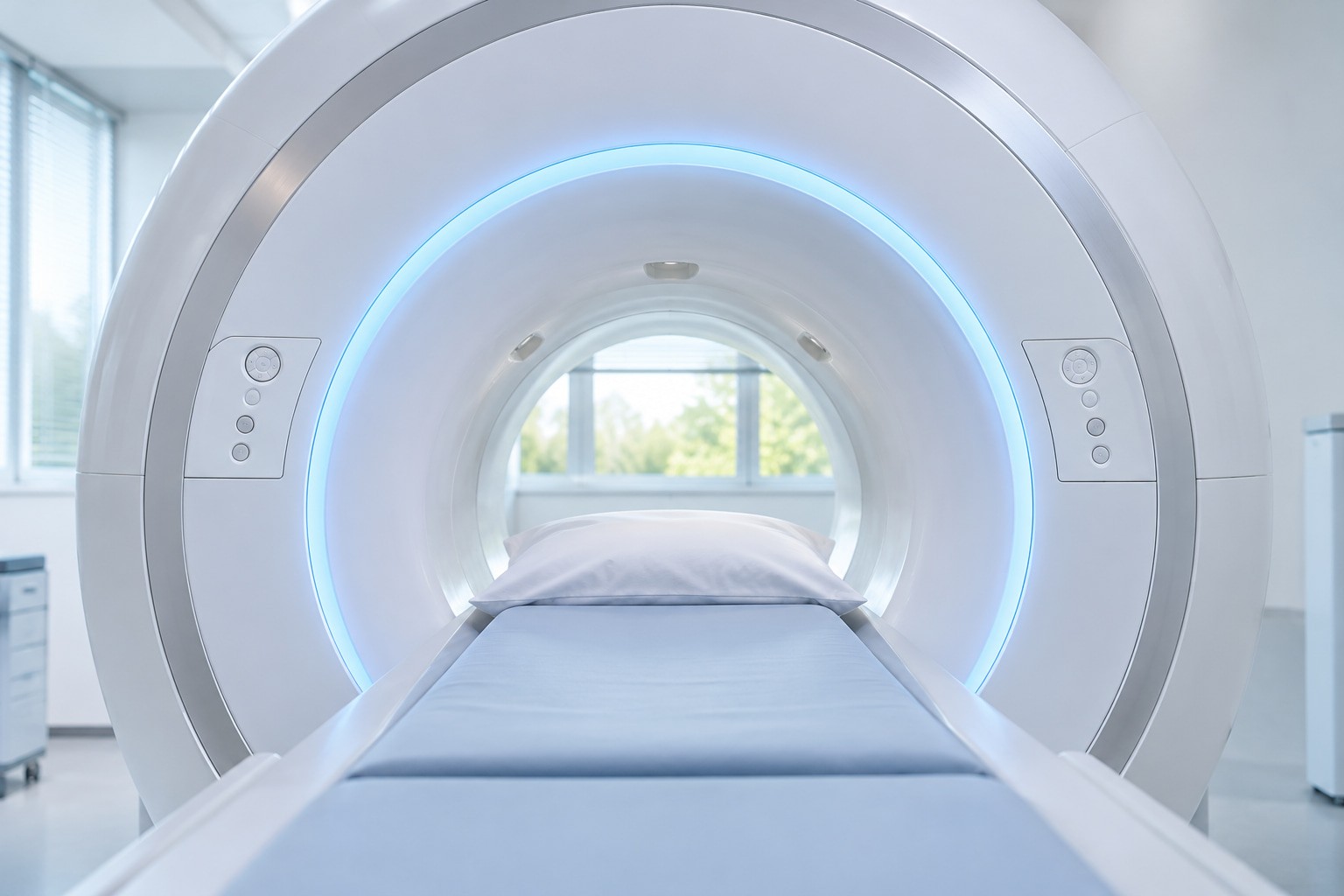
You lie on your back on a padded table, which then slides into the scanner. You are not enclosed head to toe — the tube is open at both ends, and air moves through it.
The scanner is genuinely loud: knocking, tapping and buzzing sounds as the different imaging sequences run. This is normal, and it is why you are given ear protection. The radiographer can see and hear you throughout, you can speak to them between sequences, and you are given a buzzer to press if you need to stop.
The one thing asked of you is to keep still. Movement blurs the images in much the way it blurs a photograph, and a blurred prostate MRI may not answer the question it was taken to answer.
What multiparametric means
A prostate MRI is described as multiparametric or multi-sequence because it does not take one type of picture. It runs several different sequences, each showing different properties of the tissue, and the radiologist reads them together.
That is why the appointment takes longer than you might expect, and why the scan can distinguish between tissue that merely looks unusual and tissue that behaves suspiciously. Our prostate MRI appointments are 1 hour 30 minutes, which covers the preparation and the scanning itself.
If you are claustrophobic
This is common and nothing to be embarrassed about. The important thing is to say so when you book, not when you arrive, because it gives the team time to make arrangements rather than improvising.
Options that often help include having someone stay with you in the room, a cloth over the eyes so you never see how close the scanner is, and simply knowing in advance how long each sequence lasts so the time feels bounded.
Afterwards
There are no after-effects. You can drive, eat and return to work immediately — an MRI leaves nothing in your body and has no recovery period.
The images then go to a consultant radiologist, who examines them and produces a report with a score from 1 to 5. What that score means is covered separately.
Common questions
Does a prostate MRI hurt?
No. The scan itself is painless — you lie on your back on a padded table while the images are taken. The main discomfort people report is the noise and the need to stay still for a prolonged period.
Is a prostate MRI safe?
MRI uses a magnetic field and radio waves rather than ionising radiation, so there is no radiation exposure. The main safety consideration is metal, which is why a safety questionnaire checks for implants, devices and metal fragments before the scan. Many modern implants are MRI-safe, but each needs checking first.
How long does a prostate MRI take?
A multiparametric prostate MRI runs several different imaging sequences, so it takes longer than a single scan. Our appointments are 1 hour 30 minutes, which covers preparation as well as the scanning itself.
Will I be fully enclosed in the scanner?
The scanner is a tube open at both ends with air moving through it, not a sealed capsule. You are not enclosed head to toe. If you find enclosed spaces difficult, say so when you book so arrangements can be made in advance.
Can I drive home after a prostate MRI?
Yes. An MRI has no after-effects and no recovery period, so you can drive, eat and go back to work straight afterwards — unless you have been given a sedative, in which case you will be told not to drive.
This article is general information about prostate health, not personal medical advice. It cannot take account of your own symptoms, history or circumstances. If you have symptoms that concern you, speak to your GP or a qualified clinician. Last reviewed 14 November 2026.